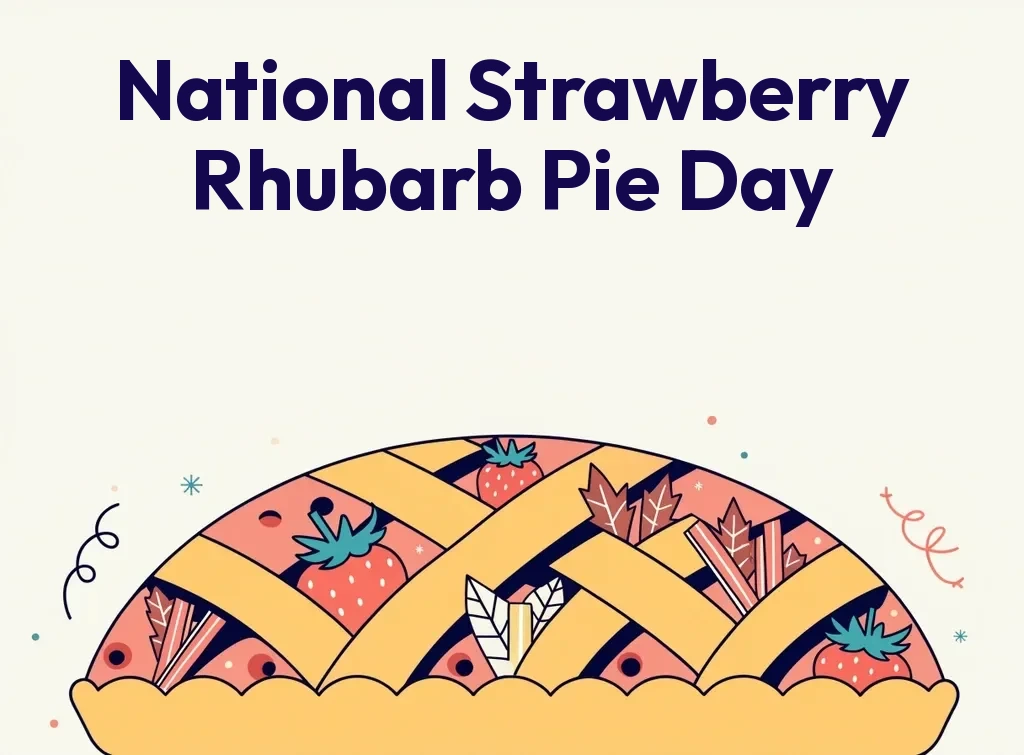
National Strawberry Rhubarb Pie Day falls every June 9 and celebrates a sweet-tart pie that pairs ripe berries with tangy rhubarb stalks. Early June is peak season for both in much of the country so the timing could hardly be better. Here’s how rhubarb earned the nickname pie plant and why a court once called it a fruit, plus tips for a filling that sets.
Quick Facts About National Strawberry Rhubarb Pie Day
| Observed on | June 9, every year |
|---|---|
| Next occurrence | Wednesday, June 9, 2027 |
| Country | United States |
| Type | Dessert day |
| Founded by | Not documented |
| Rhubarb’s nickname | The pie plant (by the 1830s) |
| Edible part | Stalks only, never the leaves |
When Is National Strawberry Rhubarb Pie Day in 2027?
Bake a lattice-topped pie on Wednesday, June 9, 2027, when farm stands in many states are piled high with both strawberries and rhubarb.
No group owns the day, so anyone can join in.
Rhubarb’s season is short in many places. Stalks are often gone by midsummer, which makes this pie a fleeting treat.
Northern growers often harvest rhubarb from spring into early summer, while strawberries peak right alongside it in June.
What Is National Strawberry Rhubarb Pie Day and Why Is It Observed?
This dessert day celebrates one of the great flavor pairings of early summer. Rhubarb is very tart on its own, so it needs a partner.
Strawberries add sweetness and juice along with bright red color. Rhubarb adds tang and a pleasant body that keeps the filling from tasting flat.
Together they balance each other, which is why the combination became a classic in American home baking.
The pie also marks the change of seasons. For many families, the first rhubarb pie of the year signals that summer is finally on its way.
Only the stalks belong in the pie. Rhubarb leaves contain oxalic acid and should be thrown away.
History and Origins of National Strawberry Rhubarb Pie Day
Nobody knows who first gave this pie its own day.
A Medicine From Asia
Rhubarb likely began in east Asia, possibly in Mongolia, National Geographic reports. The Chinese first used it as medicine, drying the roots to treat stomach troubles.
Ancient Greek and Roman healers later used the dried roots in much the same way.
How It Became the Pie Plant
Using rhubarb as a pie and tart filling dates to 18th-century Europe, University of Missouri Extension notes. By the 1830s, sweetened stewed rhubarb was so popular in America that people nicknamed it the pie plant.
Strawberries joined it later as cooks looked for ways to soften rhubarb’s sharp bite without burying it in sugar.
Fruit or Vegetable
Botanically, rhubarb stalks are leaf stems, which makes the plant a vegetable. In 1947, though, a U.S. customs court ruled that imported Canadian rhubarb counted as a fruit.
The court reasoned that people mostly eat rhubarb in pies and sweet sauces rather than as a side dish, Barnes Richardson recounts. That classification didn’t last forever.
How Is National Strawberry Rhubarb Pie Day Celebrated?
Home bakers weave lattice crusts so the bright pink filling peeks through the top of the pie.
Farmers markets sell bundles of rhubarb next to quarts of fresh strawberries, perfect for a weekend baking project.
Diners and bakeries in the Midwest and New England add slices of strawberry rhubarb pie to their June menus.
Families top warm slices with vanilla ice cream or a spoonful of whipped cream.
Gardeners who grow rhubarb share extra stalks with neighbors who want to bake their own pie.
Some cooks turn the same pairing into crisps or jam when they don’t have time for pastry.
How to Celebrate National Strawberry Rhubarb Pie Day
- Pick firm stalks. Choose crisp, brightly colored rhubarb and cut away every trace of the leaves.
- Balance the sugar. Taste your strawberries first, since sweeter berries mean you can use less sugar.
- Thicken it well. Toss the fruit with cornstarch or quick-cooking tapioca so the juicy filling sets as it cools.
- Let it bubble. Bake until the filling bubbles thickly through the vents, not just at the edges.
- Cool before slicing. Give the pie several hours to rest so the filling firms up and slices cleanly.
- Freeze extra rhubarb. Chop and freeze spare stalks so you can bake another pie after the season ends.
Interesting Facts About National Strawberry Rhubarb Pie Day
- Rhubarb stalks can be red, pink or green, and the color doesn’t always signal how sweet they are.
- Rhubarb is a perennial, so one healthy plant can produce stalks for many years.
- Gardeners usually avoid harvesting rhubarb in its first year so the roots can grow strong.
- Strawberries are not true berries in the botanical sense, since their seeds sit on the outside.
- In Britain, forced rhubarb is grown in dark sheds to produce tender pink stalks early in the year.
- A tapioca thickener gives fruit pies a glossy, clear filling that many bakers prefer.
Frequently Asked Questions About National Strawberry Rhubarb Pie Day
Are rhubarb leaves poisonous?
Yes, they shouldn’t be eaten. The leaves contain high levels of oxalic acid. Only the stalks are used for cooking, so trim the leaves off completely and throw them away.
Is rhubarb a fruit or a vegetable?
Botanists call it a vegetable because the stalk is a leaf stem. In the kitchen, people treat it like a fruit. A 1947 customs ruling once did the same for tariff purposes.
Why is my strawberry rhubarb pie runny?
Both fruits release lots of juice. Use enough thickener and bake until the center bubbles. Then let the pie cool for several hours before cutting. Draining very juicy berries first also helps.
Can I use frozen rhubarb?
Yes. Frozen rhubarb works well, though it releases extra liquid as it thaws. Add a little more thickener and bake it a few minutes longer. Don’t thaw it completely before mixing.
Why is rhubarb called the pie plant?
By the early nineteenth century, Americans baked so many rhubarb pies that the plant earned the nickname. It was one of the first fresh fillings available each spring.
Sources and Further Reading
- National Geographic – Does rhubarb deserve its killer reputation?
- University of Missouri IPM – Rhubarb, the pie plant (2016)
- Barnes Richardson – 1947: The great rhubarb controversy