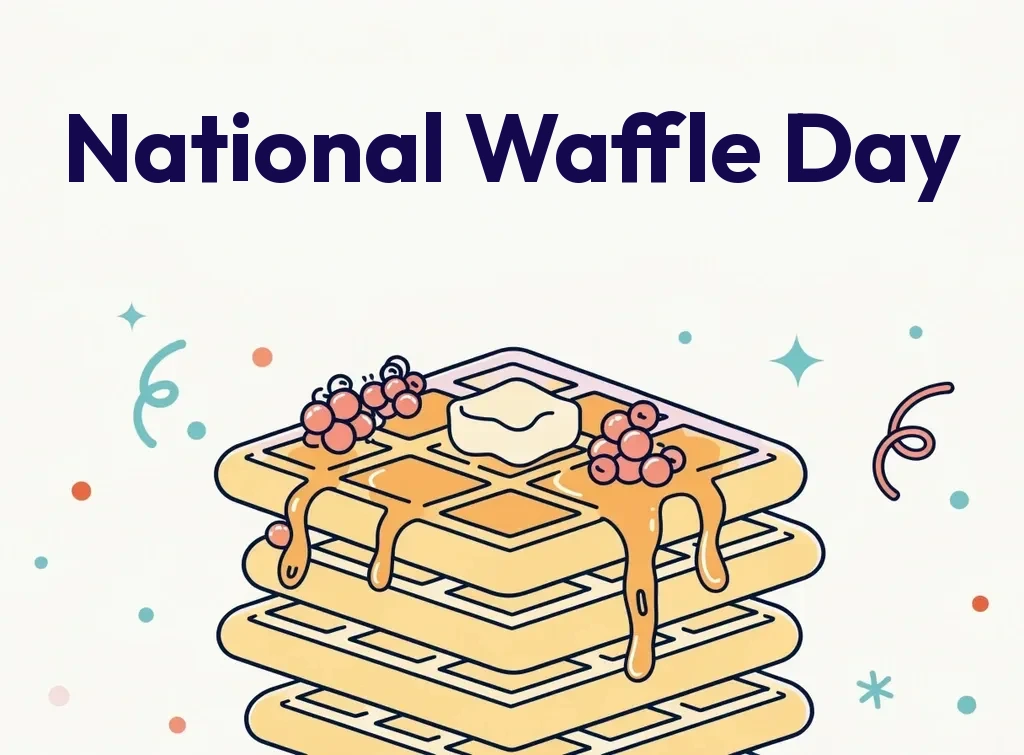
National Waffle Day falls every August 24 and celebrates the crisp, golden grid that holds pools of syrup in every square. Waffles show up at breakfast and even at dinner with fried chicken. Here’s how an 1869 patent gave the day its date and how a waffle iron inspired a sneaker, plus tips for crispier waffles.
Quick Facts About National Waffle Day
| Observed on | August 24, every year |
|---|---|
| Next occurrence | Tuesday, August 24, 2027 |
| Country | United States |
| Type | Food day |
| Date marks | First U.S. waffle iron patent, 1869 |
| Patent holder | Cornelius Swartwout of Troy, New York |
| Belgian waffle’s U.S. debut | 1964 World’s Fair |
When Is National Waffle Day in 2027?
Fire up the waffle iron on Tuesday, August 24, 2027. The date marks the first U.S. patent for the device, granted in 1869.
Restaurants and diners often run waffle specials that day, and some chains offer deals through their apps.
Don’t confuse it with International Waffle Day on March 25, which started in Sweden. Waffle fans can happily celebrate both.
What Is National Waffle Day and Why Is It Observed?
This breakfast day honors a food with a surprisingly long history and a famous American patent.
Waffles are endlessly flexible. They can be sweet with berries or savory with fried chicken, and their deep pockets make them perfect for holding melted butter and syrup.
The day also celebrates inventors who changed the kitchen. Some improved the stovetop iron, while later engineers built the electric models found in most homes today.
It’s an easy food day to enjoy at home with family on a lazy summer morning.
Restaurants join in too, from roadside diners to fancy brunch spots with whipped cream towers.
History and Origins of National Waffle Day
An 1869 Patent
On August 24, 1869, an inventor named Cornelius Swartwout received the first U.S. patent for a waffle iron. His design was easier to turn and less likely to burn the cook’s hand, Smithsonian Magazine explains.
He didn’t invent waffles or waffle irons. He added a handle and a clasp that made the iron easier to flip over a coal stove, the Hagley Museum notes.
From Greek Griddles to Dutch Irons
Ancient Greeks cooked flat cakes called obleios between hot metal plates, the National Archives reports. By the 1200s, craftsmen were making plates with the honeycomb pattern we know today.
The Dutch loved waffles, and the Pilgrims brought them to America in 1620.
Belgian Waffles Arrive
Maurice Vermersch introduced his wife’s Belgian waffle recipe at a world’s fair in Queens in the mid-1960s. Topped with strawberries and whipped cream, it became a sensation.
Waffles and Sneakers
Waffle irons changed more than breakfast. In the early 1970s, University of Oregon track coach Bill Bowerman poured rubber into his wife’s waffle iron to create a grippy shoe sole.
He applied for a patent in 1972, and Nike’s waffle trainers hit stores in 1974. One of those early shoes is now part of a Smithsonian exhibition on American business.
The National Museum of American History holds at least 50 waffle irons spanning more than 300 years.
How Is National Waffle Day Celebrated?
Families make a big batch of waffles for breakfast and set out a toppings bar with fresh fruit and warm syrup.
Diners serve chicken and waffles, a sweet-and-savory pairing that’s especially popular across the South.
Cafés feature Belgian waffles piled high with strawberries and clouds of whipped cream.
Home cooks experiment with savory waffles made from leftover mashed potatoes or cornbread batter.
Some people host waffle brunches with friends and test different batters side by side to pick a favorite.
Waffle House fans stop by one of the chain’s thousands of locations for a classic plate any time of day.
How to Celebrate National Waffle Day
- Preheat fully. A hot iron gives a crisp outside and a fluffy center, so wait for the ready light.
- Separate the eggs. Folding in whipped egg whites makes waffles lighter and taller.
- Don’t overfill. Pour just enough batter to reach the edges without spilling over onto the counter.
- Keep them crisp. Hold finished waffles on a rack in a warm oven, not stacked on a plate where they steam.
- Freeze extras. Cooled waffles freeze well and reheat in a toaster on busy school mornings.
- Try savory. Top a waffle with fried chicken or a runny egg for a hearty twist on breakfast.
Interesting Facts About National Waffle Day
- General Electric built a prototype electric waffle iron in 1911.
- Eggo frozen waffles grew from the Dorsa brothers’ waffle mix of the 1930s.
- Waffle House was founded in 1955 and serves about 145 waffles a minute.
- Early waffle irons often had decorative designs before the grid pattern took over.
- The Dutch had a waffle craze as early as the 14th century.
- A Kennedy waffle recipe was sent out as a standard White House reply to curious citizens.
Frequently Asked Questions About National Waffle Day
Why is National Waffle Day on August 24?
The date honors a patent granted in 1869 to an inventor from upstate New York for a better waffle iron.
What’s the difference between Belgian and American waffles?
Belgian waffles are thicker with deeper pockets and often use yeast or whipped egg whites. American waffles are thinner and usually rise with baking powder.
Did a waffle iron really inspire Nike shoes?
Yes. Coach Bill Bowerman poured rubber into a waffle iron to make a grippy sole, which led to Nike’s waffle trainers in 1974.
How do I keep waffles crisp?
Cook them in a fully heated iron and set them on a wire rack, not a plate. A warm oven keeps them crisp while you finish the batch.
Did President Kennedy have a favorite waffle recipe?
A Kennedy waffle recipe exists, but an archivist said it was a standard reply the White House sent to people who asked.
When did Belgian waffles come to America?
They became famous at a mid-1960s world’s fair in New York, where a Belgian family served them with fruit and cream.
Sources and Further Reading
- Smithsonian Magazine – A brief history of the waffle iron
- National Archives – What’s Cooking Wednesday: National Waffle Day (2011)
- Hagley Museum – First waffle iron patent