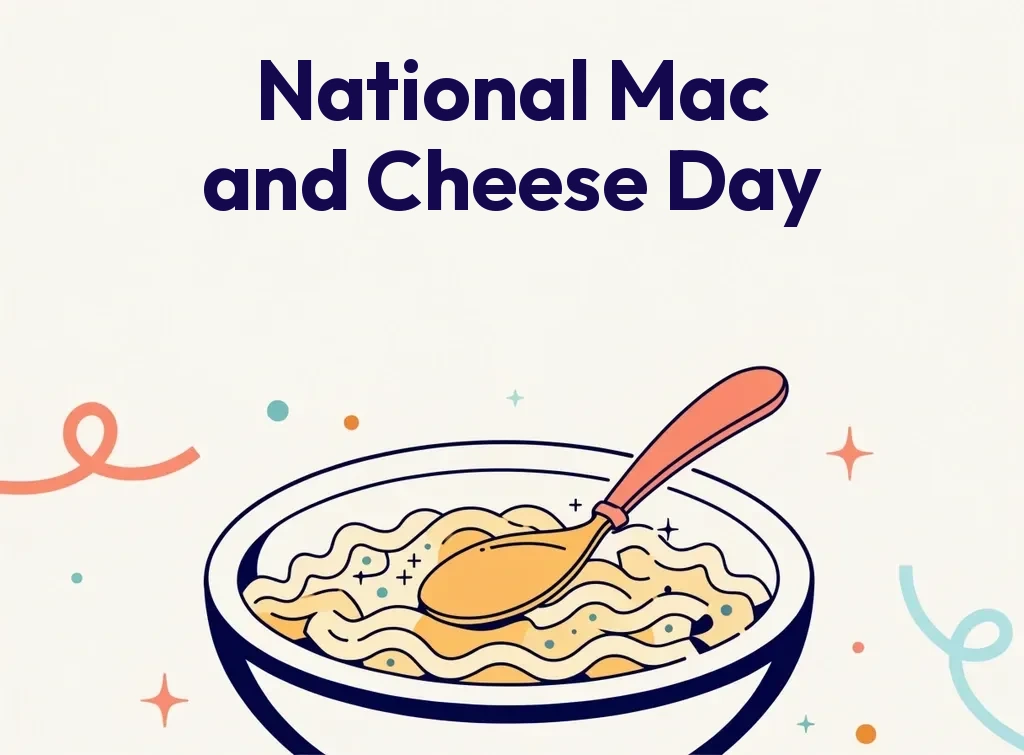
National Mac and Cheese Day falls every July 14 and celebrates the creamy, cheesy comfort food that’s a favorite of kids and adults alike. It shows up in blue boxes and holiday casseroles, and even in gourmet versions with lobster. Here’s the real story behind Jefferson’s macaroni and the enslaved chef who cooked it, plus how a Depression-era box changed American dinners.
Quick Facts About National Mac and Cheese Day
| Observed on | July 14, every year |
|---|---|
| Next occurrence | Wednesday, July 14, 2027 |
| Country | United States |
| Type | Food day |
| Founded by | Not documented |
| Earliest known recipe | 1769 |
| Boxed version launched | 1937 (Kraft) |
When Is National Mac and Cheese Day in 2027?
Stir up a pot on Wednesday, July 14, 2027. It’s a simple dinner even on hot summer nights.
Restaurants and grocery stores sometimes mark the date with mac and cheese specials or coupons.
No one has stepped forward to claim this food day. It mostly spreads through restaurants and pasta brands that enjoy any reason to promote a cheesy dish.
What Is National Mac and Cheese Day and Why Is It Observed?
This comfort-food day honors a dish that crosses every line of age and income, from college dorm rooms to fancy steakhouses.
Mac and cheese can be a quick weeknight meal from a box or a baked casserole with a crunchy breadcrumb topping. In the South, it’s often a cherished side dish at holiday dinners. Cooks bake it with eggs and several cheeses until it’s firm enough to slice.
The dish also carries a hidden history. Enslaved cooks played a major part in bringing it to American tables.
For many people, the day is just an excuse to enjoy a childhood favorite without apology.
History and Origins of National Mac and Cheese Day
Older Than Jefferson
Many people say Thomas Jefferson invented mac and cheese. He didn’t. The earliest known recipe was written down in 1769, years before his trip to Europe, Smithsonian Magazine explains.
Jefferson’s Pasta Passion
Jefferson went to France in 1784, where baked pasta with cheese was in fashion. He sketched a macaroni press and later had a pasta mold sent from Naples, Monticello’s records show.
Back home, he ordered macaroni from suppliers when he couldn’t find it locally. In 1809 he paid $8 for two boxes.
He served a macaroni dish at an 1802 state dinner. One guest, Manasseh Cutler, wrote that he didn’t like it.
The Blue Box Era
Kraft introduced boxed macaroni and cheese in 1937, during the Great Depression. One box fed a family of four for 19 cents, and the company sold 8 million boxes in a single year.
World War II rationing of meat and dairy made the cheap, shelf-stable box even more popular. Families could stretch their ration points much further.
The Chef Behind Jefferson’s Macaroni
James Hemings was enslaved by Jefferson and traveled with him to Paris. There he trained as a chef in French kitchens and learned to make pasta dishes that few Americans had tasted.
Monticello historians say the estate’s macaroni recipe was likely dictated by an enslaved chef. They name Hemings or Edith Hern Fossett, who cooked at the President’s House, as the most likely sources.
That means the people who actually made Jefferson’s famous macaroni were largely left out of the popular story for generations.
How Is National Mac and Cheese Day Celebrated?
Families make a big pot of stovetop mac and cheese and let everyone add their own toppings.
Southern cooks bake rich casseroles with sharp cheddar under a golden crust.
Restaurants feature gourmet versions with lobster or truffle oil for diners who want to splurge on a familiar favorite.
Some people try a new cheese blend, mixing cheddar with nutty Gruyère or smoked gouda.
Food trucks and pop-ups serve mac and cheese in grilled sandwiches and even as fried bites.
History lovers read about James Hemings and the cooks who shaped early American food.
How to Celebrate National Mac and Cheese Day
- Grate your own cheese. Pre-shredded cheese has anti-caking agents that can make sauce grainy.
- Undercook the pasta slightly. It keeps softening in the sauce, especially if you bake it.
- Add cheese off the heat. Stir it in gradually so the sauce stays smooth instead of oily.
- Season boldly. A pinch of mustard powder or a dash of hot sauce brings out the cheese flavor without tasting spicy.
- Top it for crunch. Buttered breadcrumbs give baked versions a golden, crisp layer.
- Chill leftovers promptly. Get them into the fridge within 2 hours, and use shallow containers so they cool quickly.
Interesting Facts About National Mac and Cheese Day
- Jefferson paid 16 cents a pound for macaroni in 1809, buying two boxes from a supplier in New Jersey.
- His secretary William Short arranged for a macaroni mold from Naples in 1789.
- Mary Randolph’s early cookbook includes macaroni dressed with cheese.
- Leftover mac and cheese keeps 3 to 4 days in the refrigerator.
- Kraft’s boxed dinner first appeared in 1937, in the depths of the Depression.
- Many Southern families serve baked mac and cheese as a holiday side dish, right next to the turkey or ham.
Frequently Asked Questions About National Mac and Cheese Day
Did Thomas Jefferson invent mac and cheese?
No. Recipes existed before he traveled to France. He helped make the dish fashionable in America after serving it at his table.
Who was James Hemings?
He was an enslaved chef who trained in Paris while working for Jefferson. Historians believe he likely brought macaroni recipes to Monticello.
Why was boxed mac and cheese so popular?
It was cheap and filling at a time when money was tight. A single box fed a family for less than a quarter.
How do I keep cheese sauce creamy?
Use freshly grated cheese and melt it over low heat. Adding a splash of milk at the end loosens a thick sauce.
Is baked or stovetop mac and cheese better?
It’s a matter of taste. Stovetop versions are creamier and faster, while baked ones have a firm texture and a crispy top.
How should I reheat leftovers?
Add a splash of milk and warm it gently on the stove or in the microwave. Heat it to 165°F so it’s safe to eat.
Sources and Further Reading
- Monticello – Macaroni
- Smithsonian Magazine – Marvelous macaroni and cheese
- USDA FSIS – Leftovers and food safety